
How to Spot Fortune-Making Stocks and Actually Hold Them.
How to find 100x stocks – What if you could turn ₹1 lakh into ₹1 crore — not by chasing trends or timing crashes, but through a simple, powerful idea: buy the right stock and hold it long enough?
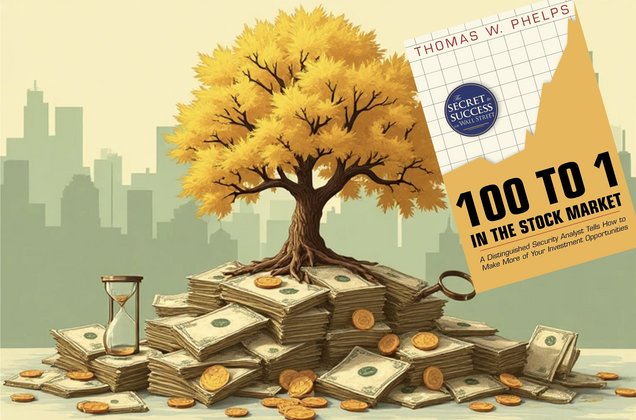
This is the foundational premise of 100 to 1 in the Stock Market by Thomas W. Phelps, a legendary investment analyst who spent decades studying the rarest and most rewarding phenomena in investing: How to find 100x stocks?
Rather than trying to forecast markets or shuffle portfolios constantly, Phelps argues that investors should focus their efforts on identifying a select few businesses with extraordinary growth potential — and then develop the rarest trait in investing: patience.
Across the book, Phelps showcases over 365 examples of such 100-bagger stocks from 1932 to 1971 — businesses like Eastman Kodak, Xerox, IBM, Goodyear, and Merck that, at some point, could have turned a ₹10,000 investment into ₹10 lakhs or more. He doesn’t just list them — he dives deep into how they looked before they became household names. Often, they were small, misunderstood, undervalued, or simply boring companies quietly compounding away in the background.
Phelps then explores why most investors fail to capture these returns, even when they get lucky enough to own such businesses. The enemy isn’t lack of information — it’s human nature. We get scared. We get greedy. We sell too early. We chase what’s moving. We listen to brokers, media, or our own insecurities. Phelps dismantles these habits and shows how they sabotage the very returns we seek.
Importantly, this is not a book of hindsight glory. Phelps makes it clear that 100x opportunities aren’t relics of the past — they exist in every decade. The challenge is to recognize them early and hold on through thick and thin. And that means developing a different mindset — one that values business performance over stock price, substance over excitement, and endurance over activity.
100 to 1 in the Stock Market is part investing strategy, part behavioral guide, and part inspirational narrative. It’s not about becoming a trader — it’s about becoming an owner. The kind of owner who can sit through volatility, ignore the noise, and emerge decades later with generational wealth.
It’s a timeless playbook for anyone who wants to turn modest investments into life-changing outcomes — not through luck, but through clarity, discipline, and time. To know – How to find 100x stocks
Core Philosophy: Buy Right, Hold Tight
The central message: fortunes are made not by frequent buying and selling, but by holding a handful of extraordinary stocks for the long term. Timing the market is nearly impossible — but identifying what to buy is within reach.
Every sale is a confession of error. Had you bought right, you would not be selling.
Key Insights & Takeaways:
1. 100-Baggers Are Real — and Plentiful
From 1932 to 1971, at least one stock each year offered a 100x return opportunity — no timing required. Phelps presents a table of 365+ such stocks, showing that long-term multibaggers aren’t rare; we just fail to hold them.
2. Compounders Often Look Boring Early On
Eastman Kodak, Goodyear, Xerox, Pfizer, and IBM were not always giants. Many were small, unloved, under-the-radar, and available for mere pennies on the dollar in their early years.
Patience is the rarest trait in investing. But it’s also the most rewarding.
3. Most Investors Ask for ‘One Donkey’
Using a brilliant parable, Phelps explains how most investors aim too low. Instead of searching for transformative businesses, they settle for 5–10% returns or quick trades.
4. You Don’t Need Many — Just One
If you get one 100-bagger in a lifetime, it can be enough to secure generational wealth. You don’t need to hit many; you just need to hold on.
5. Traits of 100x Stocks
Phelps identifies the common patterns:
- Small or mid-cap in early stages
- Strong product-market fit
- Visionary management
- Significant reinvestment into R&D or growth
- Often ignored by the herd
6. The Enemies of Wealth
What causes investors to lose out?
- Selling too early (profit booking)
- Getting scared during downturns
- Over-diversification
- Listening to the crowd
- Tax and short-term concerns
Lessons from Stories:
Phelps doesn’t just tell; he shows. Stories of Paul Garrett (who turned ~$133,000 into $14M via Xerox, Teleprompter, and McCulloch Oil) and others are powerful examples of discipline, not brilliance.
He even reflects on his own regrets — like selling Dow Jones stock for $4,500 that later became worth $1 million — reminding us that the lesson isn’t just theoretical.
Timeless Quotes:
opportunity knocks many times. the tragedy is, we don’t answer.
To make money in stocks you must have the vision to see them, the courage to buy them, and the patience to hold them.
You’ll never go broke taking a profit — is perhaps the worst advice ever offered in investing.
Warnings Against Overtrading:
Phelps slams the “performance” craze and Wall Street culture that rewards trading volume over value creation. He ridicules the habit of selling great stocks to chase hot tips or earnings whispers.
Selling a great stock just because it hasn’t moved in a few quarters is like pulling up a sapling every week to check if it’s growing.
On Underwriting & IPOs:
Surprisingly, Phelps shares that some 100-baggers came from public underwritings like Merck, Schering, and Pfizer. The key was not insider access — but holding on when others flipped.
How to find 100x stocks.:
Here’s Phelps’s 4-point filter (used by Paul Garrett):
- Small & Underfollowed
- Unique Product/Service
- Large Market Potential
- Strong, visionary, ethical management
Final Word: Why This Book Still Matters
Despite being published in the early ’70s, 100 to 1 in the Stock Market remains eerily relevant. If anything, it matters more today in a world obsessed with speed, performance metrics, and dopamine-fueled trading apps.
It’s not a book on technical analysis or modern portfolio theory — but a treatise on patience, temperament, and focus. It doesn’t promise fast money, but it shows how real fortunes are actually built.
My Personal Reflection:
Reading this book was a revelation. It’s a gentle slap to the impulsive trader inside all of us and a reminder that investing, at its core, is a slow game. A boring game. But in the end — the only game that builds wealth with silence.
This isn’t just a book. It’s a compass for anyone serious about building wealth.
Final Takeaway:
Want to build wealth? Want to know how to find 100x stocks.? Don’t just look for the next big thing. Find something great — and hold on.
For a generation caught in the trap of fast finance, Phelps offers the only strategy that truly works: vision, courage, and patience.
📘 Book Snapshot: 100 to 1 in the Stock Market
- 👤 Author: Thomas W. Phelps
- 📅 Year of Publishing: 1972
- ⭐ My Rating: ★★★★☆ (4/5) – A Timeless Classic on Wealth Creation
- 📖 Format: Paperback / Kindle / Audiobook
- 📚 Genre: Investing, Wealth Building, Long-Term Equity Strategy
- 🕰️ Ideal For: Value investors, equity enthusiasts, financial advisors, patient capital builders, and Buffett-style thinkers
- 📦 Publisher: McGraw‑Hill Book Company, Echo Point Books & Media
Audiobook (17th May 2025)
