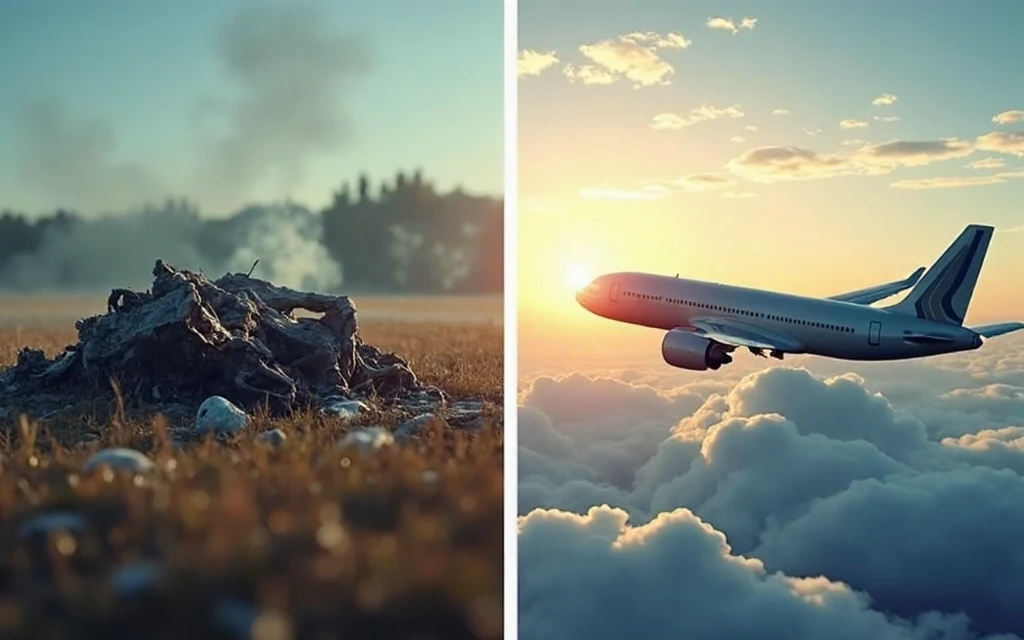

It was a quiet day yesterday, until the headlines hit – “Air India Flight AI171 crashes minutes after takeoff. Only one miraculuous survivor.”
Phones buzzed. News anchors scrambled. WhatsApp groups flooded with “Did you see this?” messages. Even those who hadn’t flown in months felt a lump in their throat.
I flied from from Hyderabad to Ahmedabad 10 days back. The news felt personal. Although I wasn’t on that fateful flight — but I have travelled to same city. Same airline. Same hour.
I stared out the window at the sky, once a symbol of possibility, now clouded with fear and despair.
“Is flying even safe anymore?”
I am not alone in asking.
When Fear Hijacks Our Minds
What I am experiencing is not uncommon. It’s what psychologists call the availability heuristic —when a dramatic, recent event warps our perception of risk.
A single plane crash, witnessed through a hundred camera angles, begins to feel more dangerous than the thousands of flights that land safely every single day.
We fear what we can picture. And crashes? They’re vivid. Fireballs, black boxes, teary families on screen.
But is fear always the truth?
From Falling Metal to Flying Miracles
I did some research and to my mental respite, the situation has magically imrpoved over the years.
In the 1950s, flying was a different beast. It was loud, expensive, and far riskier.
In 1972, over 2,300 people died in commercial aviation accidents. Pilots had minimal automation. Radar was primitive. Maintenance wasn’t digitized.
Crashes were so frequent that many flyers said prayers before takeoff.
Fast forward to today:
- Over 38 million commercial flights took off in 2023.
- The odds of dying in one? 1 in 11 million.
- You would have to fly every single day for over 30,000 years to statistically be involved in one fatal crash.
What I saw as a threat, momentarily, was actually the safest machine ever built to carry humans— crafted through years of precision engineering, constant improvement, and a relentless pursuit of safety.
Possibility vs. Probability — The Twin Realities of Risk
Here’s where the story deepens.
There is a possibility a plane will crash. Just like there’s a possibility the ceiling fan could fall or a coconut might land on your head.
But probability? That’s the actual likelihood. And that tells a very different story.
| Mode of Transport | Fatalities per Billion Passenger-Miles |
|---|---|
| Air travel | 0.07 |
| Train | 0.43 |
| Bus | 0.11 |
| Car | 7.3 |
| Two-Wheelers | 24.8+ (India) |
In short:
You are far more likely to die on the way to the airport than on the flight itself.
So why doesn’t the fear reflect the risk?
Because we fear what we don’t control. We’re okay with car accidents because we are driving. But when 35,000 feet above ground in a pressurized metal tube, trust becomes terrifying.
Crashes Make Headlines. Safety Doesn’t.
Today morning my elderly neibhour met me in the society lift and out of compassion, adviced me.
“Hardeep, maybe you shouldn’t fly for a few weeks. Just take the train, no?”
It’s a classic response, born of love—and media conditioning. I smiled and replied, half-serious, half-humorous: “Uncle, the chances of dying in a lift accident aren’t much different from a plane crash. Both are too rare to lose sleep over.”
Because let’s face it: no one reports “Flights landed safely with hundreds of passengers” 38 million times a year.
But one rare tragedy gets all the spotlight.
And slowly, we start believing the sky has turned against us.
What We Can Learn From Tragedy
Crashes like AI171 remind us that possibility is real. That systems, no matter how advanced, can fail. That aviation is still a dance between human judgment and mechanical precision.
But they also highlight something deeper: how far we’ve come.
- From smoke-filled cabins to HEPA-filtered, air-purified spaces.
- From analog dials to digital dashboards.
- From gut instinct to data-led decisions.
- From “hoping” it lands to knowing it will — because the odds are overwhelmingly in our favor.
The Final Descent — Back to Perspective
Since I already have booked my next flight, I felt a sense of uneasiness. The fear lingered.
But then I remember: I drive 120 km everyday in Hyderabad traffic. I drive on highspeed highway,. I’ve had many near misses.
Yet none of that keeps me awake at night.
Flying feels dangerous because it’s dramatic, beyond control, and seldom understood.
But facts are our compass: A plane crash is possible – It’s just not probable – And fear, while valid, should not override reason.
So here’s the truth that rarely gets headlines:
Flying is one of the safest things you’ll ever do.
Let us mourn the lives lost. Let us demand stronger checks. But let us not surrender to fear.

The fear of flying is something many of us experience, especially after hearing about accidents. It’s natural to feel anxious when we can vividly imagine the worst-case scenarios. However, the reality is that flying has become incredibly safe over the years, thanks to advancements in technology and engineering. It’s important to focus on the actual probabilities rather than letting fear distort our perception. Why do we allow dramatic events to overshadow the countless safe flights that happen every day?
I really got admired with the positive perspective even where hell whole world is on another side.
Thanks for giving in detail information and reason of why we shouldn’t fly.🛩️