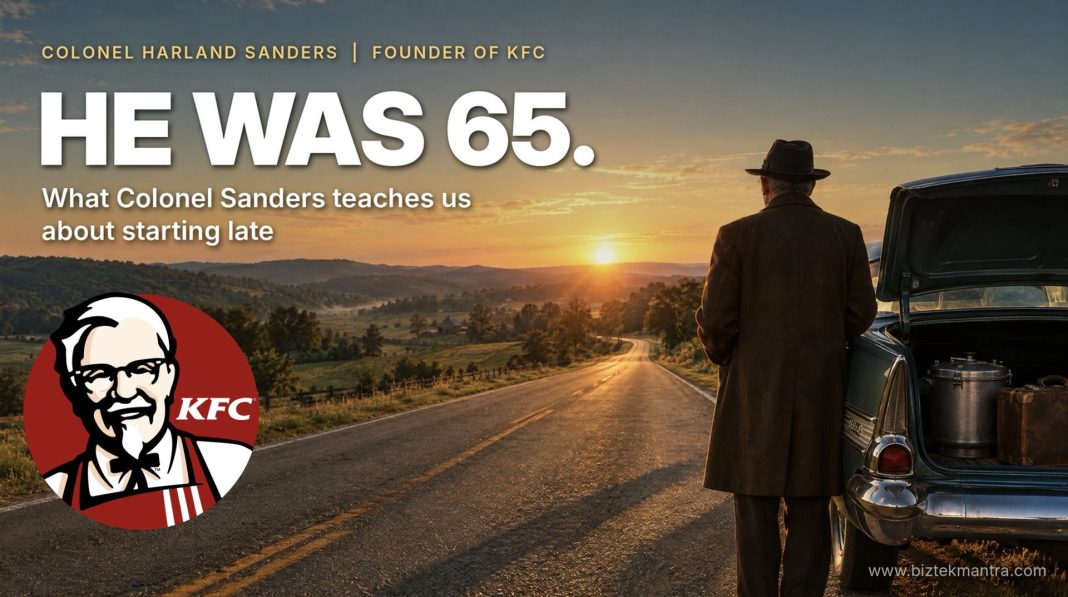

“It is never too late to be what you might have been.”
-attributed to George Eliot
I started, in fact onboarded, Citron Scientific at 41. For a good six months I kept telling myself that I was late… that the smart people had started in their twenties and I had missed the bus. Then I read about a man who started at 65, with no money and no partner, and built one of the most recognised food brands on the planet.
The man is Colonel Harland Sanders. You know him as the Colonel on the KFC bucket. What most of us do not know is how late, how broke and how stubborn he was when the real story began.
I shared a short version of this story on LinkedIn. It deserved more than 200 words. So here it is, along with the four business lessons I keep coming back to.
The day the highway moved
Sanders was born in Indiana in 1890 and lost his father at five. By his forties he had been a farmhand, a streetcar conductor, a railroad fireman, an insurance salesman and a tyre salesman. He was fired more often than he was promoted.
In 1930, at 40, he started serving chicken to travellers at his service station in Corbin, Kentucky. The food was good enough that the station became a cafe, the cafe grew a motel, and in 1935 the Governor of Kentucky made him an honorary Colonel. By 1940, at 50, he had worked out how to pressure-fry chicken in under ten minutes without losing the taste. That was the real invention. Everything else grew out of it.
Then the government announced Interstate 75. The new highway would carry the traffic seven miles away from his front door. The travellers who kept his cafe alive would never see his sign again. In 1956 he sold the place, settled his debts and was left with a Social Security cheque of around $105 a month. He was 65.
Most people would call that retirement. He loaded a pressure cooker, a sack of flour and his recipe into the car and drove from restaurant to restaurant, cooking for owners in their own kitchens. If they liked what they ate, the deal was a handshake and a few cents for every chicken sold. Legend says he heard “no” more than a thousand times before anyone said yes.
By 1964 there were more than 600 outlets. He sold the company for $2 million. He was 73.
Lesson 1: Your real asset is rarely the building

Sanders lost the cafe, the motel and the sign on the highway. What he kept was a recipe and a method that nobody else had. The restaurant died; the recipe travelled.
Ask yourself an honest question. If your office, your showroom or your warehouse disappeared tomorrow, what would you still own? If the answer is “not much”, you have been building a location, not a business.
In distribution we fall into this trap all the time. We think the asset is the stock in the godown or the brands on the price list. It is not. The asset is the relationship with the customer, the knowledge of what they need before they ask for it, and the process that delivers it without fuss. Those three things fit into a car. Everything else can be rebuilt.
Lesson: Know exactly which part of your business is the recipe. Protect that. The rest is furniture.
Lesson 2: Distribution beats location
For 26 years Colonel Sanders waited for customers to drive to him. When the road moved, the waiting stopped working. So he reversed the model. Instead of asking people to come to his kitchen, he took his kitchen to people who already had customers.
Think about what that meant. Every restaurant owner who signed up brought his own building, his own staff and his own regulars. Sanders brought the one thing they did not have. He did not compete with them for the diner; he rode on it.
This is the lesson I find most people resist, and I include myself. We are all a little in love with our own location. But reach is almost always worth more than ownership. The question is not “how do I get more people to come here?” The question is “who already has the people I want, and what can I give them that makes carrying my product worth their while?”
Lesson: Stop waiting at the counter. Find the people who already have the footfall and make yourself useful to them.
Lesson 3: No capital forced a better model
Here is the part I like most. Colonel Sanders could not have opened 600 restaurants even if he had wanted to. He had no money, no bank behind him and no partner with deep pockets. So he built a system that other people could run, and got paid on every piece of chicken they sold.
Franchising was not his first choice. It was the only door that was open, and it turned out to be the better door. A few cents a chicken sounds like nothing… until it is 600 kitchens frying chicken every single day.
Constraints do this to you. When the obvious route is closed, you are forced to find a route that scales without you standing in the middle of it. I have seen this in our own business more than once. The plan we could afford usually turned out smarter than the plan we wanted.
Lesson: When you do not have the money, do not postpone the idea. Design a model that does not need the money.
Lesson 4: It is never too late to start
Everything above is strategy. This one is about you.
Colonel Sanders was 40 when he fried his first chicken for a paying customer. Fifty when he perfected the method. Sixty-two when he sold his first franchise. Sixty-five when he hit the road full time. Seventy-three when he cashed out. At every one of those ages, someone would have told him it was too late.
We treat age like a verdict. It is a data point. What actually ran out for Colonel Sanders was not time… it was excuses. The highway took away the last one he had.
So let me ask you what I asked myself at 41. What is the recipe you are still sitting on? The product idea, the side business, the book, the course, the difficult conversation with a partner you have been avoiding for months. You already know what it is. Believe me, you are not too late. You are only early for the version of you that finally starts.
Tell me in the comments what your “65” moment looks like. I would love to read it.
You may also like: Brad Pitt’s F1 is More Than Racing – It’s Business Strategy in Motion and The Salesperson AI Cannot Replace.
