

A few years ago — long before I had ever heard the term Dunning-Kruger effect — I sat in a meeting where the least experienced person in the room did most of the talking.
He had strong opinions on everything — marketing, hiring, product, even things he had touched only once. And the strange part? He wasn’t bluffing. He genuinely believed he knew it all. Meanwhile, the real expert in the corner — the one who had spent fifteen years in the field — stayed quiet, occasionally offering a careful “well, it depends.”
I remember thinking: why is the person who knows the least so sure, and the person who knows the most so hesitant?
Years later, I found a name for what I had witnessed. It’s called the Dunning-Kruger effect. And once you understand it, you start seeing it everywhere — in boardrooms, on WhatsApp groups, in television debates, and, if we’re honest, in the mirror.
A Bank Robber, a Lemon, and a Big Idea
In 1995, a man named McArthur Wheeler robbed two banks in Pittsburgh in broad daylight. No mask. No disguise. Just a confident smile at the security cameras. When the police arrested him hours later, he was genuinely stunned. “But I wore the juice,” he protested.
Wheeler believed that rubbing lemon juice on his face would make him invisible to cameras — because lemon juice is used as invisible ink. He was so confident in his flawed logic that he never once questioned it.
This bizarre story caught the attention of two psychologists at Cornell University, David Dunning and Justin Kruger. It made them ask a deceptively simple question: what if the people who are most incompetent are also the least able to realise it?
So What Exactly Is the Dunning-Kruger Effect?
In 1999, Dunning and Kruger published their now-famous study. They tested people on grammar, logic, and humour, then asked them to rate their own performance.
The results were eye-opening. The people who scored the lowest consistently believed they had done far better than they actually had. Some of the worst performers even thought they were above average.
The reason is subtle but powerful: the very skills you need to be good at something are the same skills you need to know whether you’re good at it.
If you don’t know grammar, you can’t tell that your grammar is poor. If you can’t sing, your own ears won’t warn you. Incompetence, in other words, comes with a built-in blindfold.
The Dunning-Kruger Curve We All Climb
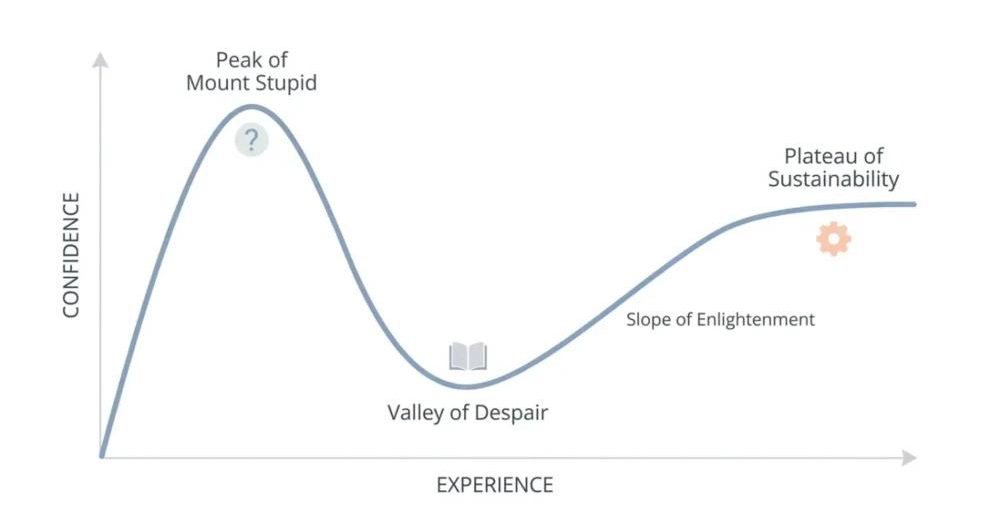
Over time, people began drawing this idea as a curve, and it has an almost poetic shape. It begins with a steep spike often nicknamed “Mount Stupid” — that early rush of confidence when you’ve learned just enough to feel like a genius. You watch two YouTube videos and suddenly you’re ready to argue with cardiologists and central bankers.
Then comes the crash. As you learn more, you realise how much you don’t know. Confidence tumbles into what many call the “Valley of Despair.”
But if you keep going — keep learning, failing, correcting — you slowly climb the “Slope of Enlightenment.” Confidence returns, but this time it’s earned. It’s quieter. It’s backed by real understanding.
Why the Dunning-Kruger Effect Fools Us
It would be easy to laugh at all this, but the Dunning-Kruger effect isn’t a sign of stupidity. It’s a feature of being human — just one of the many cognitive biases that quietly shape the way we think. Our brains crave certainty. Admitting “I don’t know” feels uncomfortable, even threatening. So we fill the gaps with confidence, because confidence feels safe.
There’s also ego. Nobody wakes up wanting to feel average. We quietly rate ourselves as better-than-average drivers, better-than-average judges of character, better-than-average investors — even though, statistically, half of us must be wrong.
And here’s the uncomfortable truth: the less we know about a subject, the easier it is to imagine that it’s simple. Complexity only reveals itself once you step inside.
The Flip Side — When Experts Doubt Themselves
There’s a mirror image to all this that we talk about far less.
While beginners often overestimate themselves, genuine experts frequently underestimate themselves. Because they understand the full landscape of a subject, they also see all its exceptions, grey areas, and unknowns.
This is why the smartest person in the room is often the one saying “I’m not entirely sure.” It’s also the root of impostor syndrome — that nagging feeling many talented people carry, convinced they’ll one day be “found out.” So we end up with a strange world: the loud and clueless drown out the capable and cautious. Recognising this pattern is half the battle.
How to Outsmart Your Own Ignorance
The tricky thing about the Dunning-Kruger effect is that you can’t spot it in yourself the way you spot it in others. But a few habits help.
First, assume you’re standing on Mount Stupid more often than you’d like to admit. A little humility is a cheap insurance policy against big mistakes.
Second, get feedback from people who will actually tell you the truth — not the ones who simply nod along. Real growth lives in honest criticism.
Third, keep learning past the point where you first feel confident. That initial burst of confidence is usually the most dangerous, not the most reliable.
And finally, get comfortable saying three underrated words: “I don’t know.” They aren’t a weakness. They’re the beginning of real competence.
The Quiet Confidence of Knowing You Don’t Know
That colleague from years ago eventually moved on, still supremely confident, still convinced he had all the answers. I’ve thought about him often — not to judge him, but because I’ve caught myself doing the exact same thing. Speaking too soon. Assuming too much. Standing proudly on my own little Mount Stupid.
The Dunning-Kruger effect isn’t a flaw in other people. It’s a reminder for all of us.
The goal isn’t to never be wrong. It’s to stay curious enough, and humble enough, to notice when we are. Because in the end, wisdom rarely shouts. It usually whispers, “let me think about that a little more.”
