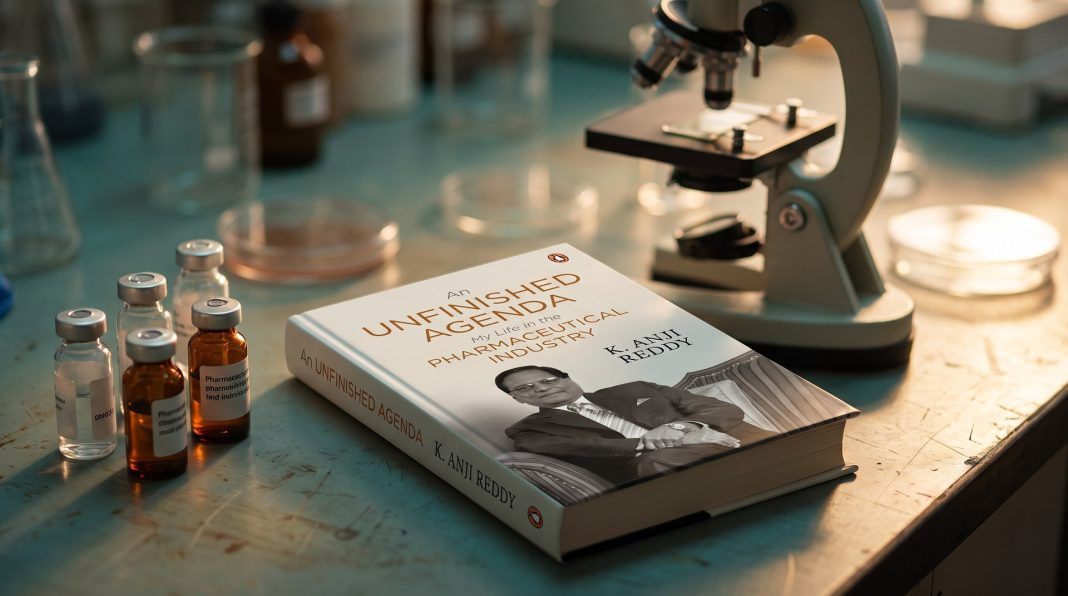

I live in Hyderabad, and you cannot work anywhere near the pharmaceutical business in this city without walking, every single day, in the long shadow of Dr Kallam Anji Reddy. His company is on our skyline. His people are in every lab, every plant, every campus. So when I finally picked up An Unfinished Agenda: My Life in the Pharmaceuticals Industry, I braced myself for the usual fare — a successful man telling us, comfortably in hindsight, how right he had always been.
An Unfinished Agenda refuses to play that role. And that is exactly why it stayed with me.
Published by Penguin in 2015, two years after Dr Reddy passed away in March 2013, this memoir is not a victory lap. The clue is sitting right there in the title. Here is a man who built one of India’s most celebrated pharmaceutical companies, put Indian science on the world map, and still chose to call his life’s work unfinished. Read that again. Not “accomplished”. Not “mission complete”. Unfinished. That single word tells you almost everything about the temperament of the man.
More than one man’s story
Dr Reddy’s story begins a long way from the glass-and-steel vocabulary of global pharma. Born in 1941 in the small town of Tadepalli in Andhra Pradesh, a turmeric farmer’s son, he graduated in chemistry from Guntur, went on to pharmaceutical technology at UDCT Bombay and a doctorate at the National Chemical Laboratory in Pune. He took his first job at Indian Drugs and Pharmaceuticals Limited (IDPL) in 1967 — and it was there, in that public-sector setup, that his entrepreneurial spirit first took shape. The founding of Dr Reddy’s Laboratories came later, in 1984.
But the memoir is quietly telling a second story alongside the first — the story of a nation growing up. India travelled, in Dr Reddy’s own lifetime, from a country dependent on the West for its medicines to a country that made its own, and then went on to supply affordable generics to the world. Dr Reddy never places his company above that larger current. He places it within. His rise and India’s rise are the same story told twice.
The voice is plain, unhurried, anecdotal. There is no chest-thumping here, no manufactured drama. He simply tells you what happened, what he learned, and where he fell short. He is generous, too — naming his teachers, his mentors, even his rivals, from Cipla’s legendary Dr Yusuf Hamied to Bhai Mohan Singh of Ranbaxy. For a book by a man of his stature, the restraint is striking — and refreshing.
The night the moon changed his mind
Every founder has that one moment when the world suddenly looks bigger. For Dr Reddy, it was Neil Armstrong walking on the moon in 1969.
He writes of being shaken by it — not merely impressed, shaken. If human beings could stand on the moon, then surely the word “impossible” needed to be used with a lot more caution. He credits that very event with the courage to eventually build his own company and chase the dream of affordable medicine. That thought runs underneath the entire book. Dream big, prepare seriously, and then simply refuse to quit.
And here is the part I found most useful. Dr Reddy never treated science and business as rivals pulling in opposite directions. Many founders today talk endlessly of disruption. Dr Reddy talks of capability — can we actually master the hard science, build processes that hold, and make our work matter in the life of a patient who needs it? Disruption is a slogan. Capability is a discipline. The difference between the two is the whole book.
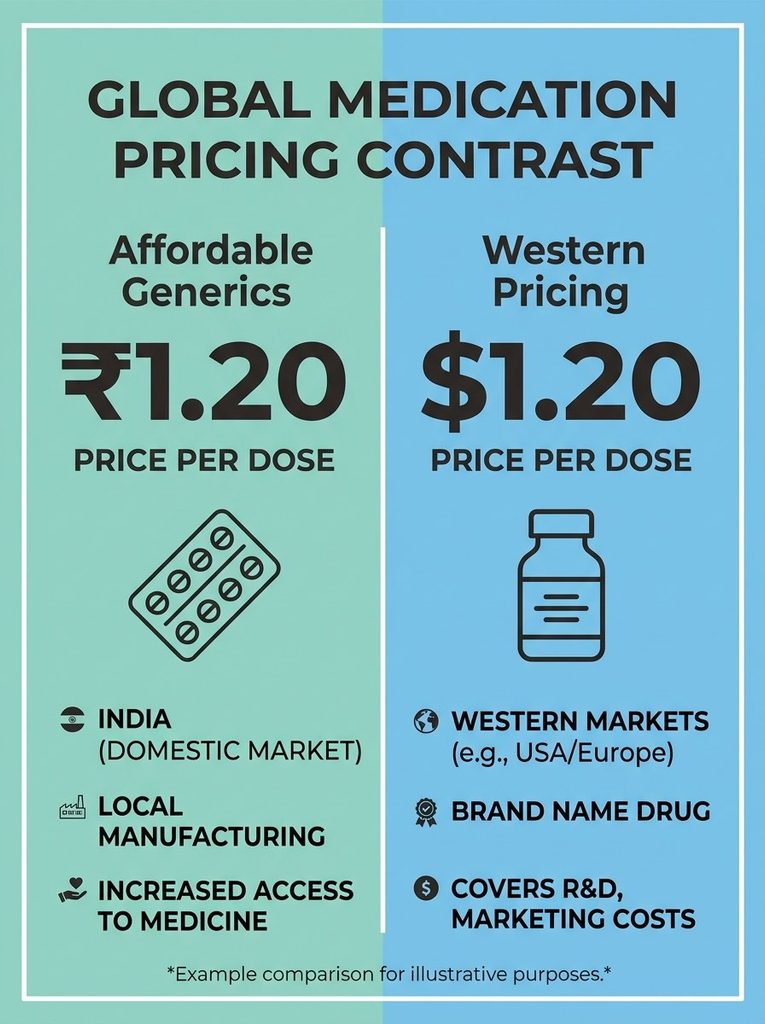
₹1.20 against $1.20
If there is one number in this memoir that should be taught in every business school in India, it is this one.
Dr Reddy started out making bulk drugs — the active ingredients that other companies turn into finished medicines. India’s 1972 patents legislation had opened the door for domestic players to build real manufacturing muscle in this space. But Dr Reddy noticed something that troubled him. Cheaper bulk drugs did not automatically mean cheaper medicine for the patient standing at the chemist’s counter. Many companies were simply unwilling to pass the saving on. It was disappearing somewhere between the factory and the sick.
So he came up with a formula so simple it was almost cheeky — one dollar equals one rupee. His anti-hypertensive enalapril was launched under the brand Enam and priced at ₹1.20. The same molecule cost about $1.20 in the United States.
Same figure. Same digits. Roughly eighty times the difference in real money.
That was not a clever marketing gimmick. It was an argument — moral and commercial at once — that a life-saving therapy has no business staying out of an ordinary person’s reach. He did the same elsewhere, slashing the price of formulations like norfloxacin and ciprofloxacin by close to 90 percent. And, predictably, cheaper medicine did not make him popular in every boardroom. Cut a price and you serve the patient; but you also disturb a great many comfortable arrangements, and the resistance comes quickly.
This is where the book earns its place on an Indian shelf in particular. Dr Reddy refused to separate price from purpose. For him, affordable medicine was never charity handed out after the profits were counted. It was built into the business model from day one.
Building a company the world would take seriously
Dr Reddy wanted something more than a successful Indian company. He wanted Indian science to be believed — abroad, by the sceptics, by the analysts who assumed nothing good in medicine ever came out of India.
The pursuit of a New York listing came from exactly this hunger. It was never only about raising money. It was about standing on the world’s most scrutinised stage and being counted. In April 2001, Dr Reddy’s Laboratories became the first pharmaceutical company from Asia, outside Japan, to list on the New York Stock Exchange — raising around $133 million through American Depositary Receipts. Pause on that. Not the first Indian pharma company. The first from the whole of Asia bar Japan. That is the size of the bet he made.
The road there was anything but smooth, and Dr Reddy does not pretend otherwise. But the milestones stacked up. Dr Reddy’s was the first Indian company to out-license a novel molecule to a multinational innovator. And in August 2001, it became the first Indian company to win the coveted 180-day marketing exclusivity in the US generics market — for its fluoxetine 40 mg capsules, the generic version of Eli Lilly’s Prozac. That single product, over that six-month window, generated close to $70 million — almost all of it profit. Each of these “firsts” is a different kind of acceptance — financial, scientific, regulatory — and together they announced that an Indian company could compete on quality, and not merely on cost.
The hard, honest lesson of Betapharm
Now we come to the chapter that, for me, makes the whole book trustworthy.
In 2006, Dr Reddy’s Laboratories bought the German generics company Betapharm for around $560 million — at the time, the biggest overseas acquisition by any Indian company. On paper, it was brilliant. Betapharm gave instant scale in Europe’s biggest generics market: a ready product basket and a deep sales force. Dr Reddy’s even outbid Ranbaxy to win it. This was ambition of the boldest kind — buying, in one stroke, what years of slow organic growth could not deliver.
And then the ground shifted.

In 2007, Germany changed the rules — handing insurers the power to procure medicines through tenders, which quietly killed the importance of the individual doctor’s prescription. That was the very thing Betapharm’s old sales model was built to influence. Margins collapsed under fierce discounting. The company wrote the investment down, and Dr Reddy’s Laboratories posted its first-ever annual loss in 2008–09 — a consolidated loss of over ₹900 crore, driven almost entirely by write-downs on Betapharm’s goodwill and intangibles. In the space of a single year, the company lost more than half of everything it had earned in the previous five.
Most memoirs would bury a story like this. Dr Reddy puts it on the table, and his disappointment is plain on the page. He does not soften it into a tidy “learning experience” and move on. And the lesson that comes out of it is one I keep returning to in my own line of work: your analysis is never complete if it stops at the company and the market. There is a third player in the room — the regulator, the policy, the way the payment actually works — and in a regulated industry, that player can rewrite your economics faster than any operational improvement can rescue them. A great portfolio and a strong sales team can lose their value overnight when the rules of reimbursement change under your feet.
The agenda that stayed unfinished
The true weight of An Unfinished Agenda sits in this section.
Generics had made Dr Reddy’s a global name. But there was a deeper hunger the man never let go of — to discover an original, new drug from India. Not to copy a molecule well, but to create one. He wanted, in his own words, to build a company that would last 500 years, the way Merck had.
He set up a discovery laboratory early. By 1997, he had out-licensed his first molecule, balaglitazar — an anti-diabetic named in honour of Lord Balaji at Tirupati — to Novo Nordisk. This was a first for any Indian company, and it made the pharmaceutical world sit up. In 1998 came the bolder swing — ragaglitazar, a first-in-class molecule that could treat diabetes and lower harmful cholesterol, with the potential to be a genuine blockbuster. There is an entire chapter in the book devoted to it, and you can feel his heartbreak in every line, because neither molecule made it. Ragaglitazar was halted in 2002 after tumours turned up in animal studies; balaglitazar fell victim to the same class of safety concerns that later felled other glitazones worldwide.
He does not treat this as a footnote. It is the emotional heart of the book. And that is why “unfinished agenda” is not a modest, decorative phrase tacked onto a completed life. It is an honest confession that the dream of Indian drug discovery needed longer horizons, heavier risk, and a scientific ecosystem far larger than any one company — however good — could build alone.
Strangely, this is what lifts the book rather than lowers it. Dr Reddy’s legacy is not made smaller by the fact that the agenda stayed open. If anything, the memoir argues — through the shape of his own life — that meaningful work is often measured by the problems we are willing to leave for the next generation to carry forward.
The part he chose to end on
Here is the thing worth noticing. A man could have closed a book like this on the NYSE bell, or on a molecule, or on a balance sheet. Dr Reddy chose to close his on the people his medicine was meant for.
The final movement of the memoir turns to the social dimension of his work — the Dr Reddy’s Foundation and, especially, the Naandi Foundation, among the most respected non-profits in India, working across health, education and livelihood. This, in the end, is where he wanted the story to rest. Not on what the company was worth, but on what it was for. And it is precisely this choice of ending that makes the title land the way it does. The agenda he considered unfinished was never only the science. It was the far larger business of making sure medicine reached the people who needed it most.
Science, enterprise, and a sense of duty
There is one thread running through these pages that I do not want to pass over — Dr Reddy’s stubborn belief that medicine carries a purpose beyond the balance sheet. Merck is his lodestar throughout, and the memoir closes on George W. Merck’s immortal line: “We try never to forget that medicine is for people.” That sentence is, in many ways, the whole book compressed into nine words.
Do not misread this as some argument against profit. His worldview is far more demanding than that. He wants both — durable financial success and genuine human purpose — and he believes they feed each other, so long as a company never forgets that its medicines are made for people who are unwell. His own career keeps proving the point, tying hard commercial strategy to affordable pricing, serious research and steady institution-building.
Even a small detail lingers. His discovery laboratory was built beside a grape garden that he tended himself, almost every day. A man who cared that much about the setting in which his scientists thought was, clearly, a man who understood that great science is not squeezed out of people; it is grown in the right conditions.
An Unfinished Agenda: So, Should You Read It?
Go in expecting a thoughtful industry memoir, not a racy personal biography, and you will be well rewarded. Its strengths are its clarity of purpose, its first-hand detail, its wide view of how Indian pharma actually grew up, and above all its willingness to sit with failure as openly as with success.
Entrepreneurs, researchers, doctors and anyone curious about the story of Indian business will find a great deal here. Fair warning — there is a fair bit of chemistry in these pages, and if you are not from the pharma world some of it will sail past you, as it did me. It doesn’t matter. What comes through, unmistakably, is a man in love with science and stubbornly determined to make its fruits affordable.
If you are the sort of reader who wants scandal, score-settling or a blow-by-blow attack on every old policy, the restraint may leave you wanting. The book does not dwell much on the industry’s controversies or thunder against the earlier regulatory regime. But that quiet is entirely in character. This is a book about building, learning and looking ahead — not about looking over the shoulder.
And that, in the end, is what makes An Unfinished Agenda a fitting tribute to the man. It does not hand us an untouchable icon. It hands us the discipline behind the ambition — to make medicine affordable, to plant the Indian flag on the global stage, and to keep chasing discovery even when the odds were long and the outcome uncertain.
Five Things An Unfinished Agenda Taught Me
- Affordability can be a strategy, not a favour. Dr Reddy’s shift from bulk drugs to finished formulations was driven by a simple conviction — if it costs less to make, the patient should pay less. Build that into the model, not into the CSR report.
- Big science needs big scaffolding. Bold scientific dreams are worth little without the laboratories, the skilled people, the capital, and the patience to keep going through failure. Ambition and institution have to grow together.
- Policy can undo you faster than the market. Betapharm is a permanent reminder that in a regulated business, a change in reimbursement rules can wipe out value quicker than any amount of operational brilliance can restore it. Always count the regulator as a player at the table.
- Failure is not the opposite of purpose. The stalled drug-discovery programmes did not erase Dr Reddy’s vision. They are the very reason the mission remained unfinished — and worth continuing.
- A medicine company owes something to the public. The most enduring idea in the book is also the simplest — medicine must stay connected to the people who need it. Dr Reddy ended his own story on Naandi, not on a share price. That choice tells you everything.
If you have read An Unfinished Agenda, I would love to know what stayed with you. And if you haven’t — and you care even a little about how India built its medicine — this one deserves a place on your shelf.
